How I Ended Up with an ADHD Diagnosis, Part 1.
It’s pretty wild how a diagnosis can end up being a puzzle piece you’ve been searching for your whole life. Here is part 1 of 2 of my ADHD journey: how I got there.
I have always questioned if something was wrong with me, and grew up knowing and feeling like there was something different about me than everyone else. I have always been a relatively hypervigilant person, and finding motivation and focus was a constant struggle for me. Now that I’m here and diagnosed, it’s hard to look back at my “growing up” years and unsee all the telltale signs. I grew up with an overly critical mom who called me lazy on a regular basis, I’d often get grounded for having big emotions and impulsively lashing back (“sassing my mother” was 9 out of 10 times the reason for my punishment), and was a skilled procrastinator, waiting till the last minute to complete any project, paper, or assignment.
I remember several years ago, as my understanding of ADHD started to shift from “little boys bouncing off the walls” to “ADHD looks different in everyone, especially girls,” I asked my now husband, Clayton, if he thought that I had it. I obviously had a hard time staying focused, I’d zone out sometimes in conversation before snapping back into reality, I’d not hear what he’d say even when I was staring directly at him, I startled easily…the signs were all there. Together we chalked it up to just me having a hard time hearing (I lost most of my hearing when I was 5) and moved on from it.
In my work as a therapist, I started having more female clients come to me either with concerns that they had ADHD, or already ha an ADHD diagnosis. This played a huge role in shifting my interpretation of ADHD even more, as the women I work with are all incredible—smart and charismatic, talented and ambitious, loved school and learning new things, personable and surrounded by loved ones. I thought to myself, “If these women could have or do have ADHD, does that mean it’s possible that I have it too?” I started to learn more about how it presents in women, but never actually went so far as to feel confident I might have it as well.
Last summer, Clayton and I took our belated honeymoon trip to Europe, which was full of so many memorable moments, delicious bites, and lots of “we love each other” time. It was also, for me, full of a lot of frustration, irritation, and anxiety. Something that has always been hard for me is the transition time of traveling—getting from one place to the next, getting dysregulated by how overstimulated I was in a new place, the pressure of planning and scheduling all the fun things we wanted to do, unexpected travel delays and cancellations. He and I had scheduled ourselves to visit 6 cities in 2 countries, and all the usual stressors for me were multiplied sixfold. I found myself anxious, stressed, frustrated, and irritable for a big chunk of our trip, which of course affected Clayton.

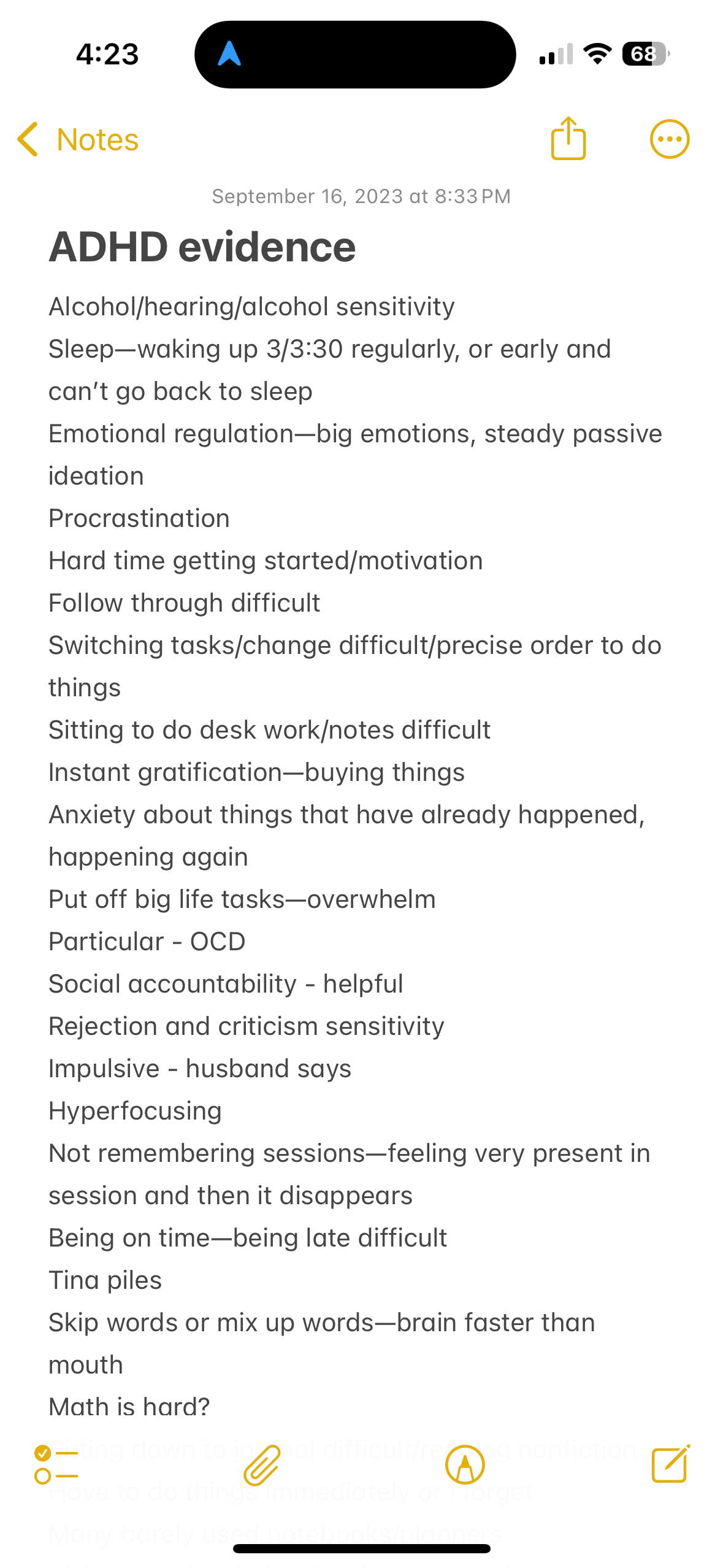
A month or so after we returned from our trip, Clayton ever-so-gently sat down on our couch next to me, a welcome, though temporarily irritating, break from my cell phone scroll-spiral. He said to me, “Hey babe, my therapist sent me this podcast about neurodivergence, and I think you might have ADHD.” He really couldn’t have delivered it any better, and I remember feeling so understood and validated in that moment—finally someone else saw what I had seen and felt for a while. Within 24 hours, I made an appointment to see my primary care doctor to discuss, listened to the podcast episode from Clayton’s therapist, and went down a deep rabbit hole (we ADHD-ers call this “hyperfixation”) on anything ADHD-in-women related as I prepared my list of symptoms for the doc.
Stay tuned for part 2, where I talk about my doctors’ appointments, medication, grief of what my life could have been, shame, and beyond.